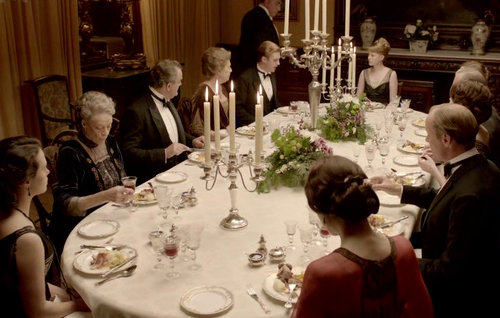
Although
most do not stop to think about why, meals are scarce in literature for the
most part. Due to the fact that it is extremely difficult to write about an
event so commonplace as sitting down to join in a meal in an interesting way,
authors rarely include the gathering unless it is to signify something bigger
and more important. As Foster says, eating is usually considered a very
intimate occurrence. Thus, eating in literature often signals a turning point
in the way one character feels toward another.
Meals
can also point to status. Elaborate foods and serving dishes signify high
status and abundant wealth, cluing the reader in to the every day lives of the
characters, whereas smaller portions and simpler foods tend to indicate lower
status. By using something that everyone takes part in, every reader is able to
relate to the characters on some level. In a sense, it brings the reader closer
to all of the characters that are eating in addition to uniting the characters
taking part in the activity. This is incredibly important in literature because
most people hesitate to continue reading if they do not relate to the
characters or their experiences in some way or another.
An
advantage of taking the time and energy to write about a meal is that it can convey
something much more interesting and complex than simply ingesting sustenance.
In Virginia Woolf’s essay “Two Meals,” she is able to describe something as
intricate as the differences between how men and women were treated using only
the descriptions of the meal she received at two colleges she visited: the
men’s college and the women’s college. At the men’s college, she was treated to
luxuriant dishes and multiple courses. However, at the women’s college, she was
given a very plain and altogether unremarkable meal. With her accounts of the
meals, she achieved something much larger than simply recounting and reviewing
the meals she received. “Two Meals” is a prime example of how meals are shown
in literature. Woolf was able to make a statement about society and the
treatment of women with only two paragraphs, which goes to show the impactful
way meals can be portrayed in literature.
As
Foster says, meals in literature are not always good omens. Because of the way
we treat meals as a sign of friendship and peace, we are all the more upset
when one of the people at the meal is revealed to have been plotting against
the others. This immediately turns us against the character that had been
conspiring against someone who trusted them enough to invite them to a meal
together. This nearly instantaneous reaction has been ingrained into our brains
from the time we were young children through the importance most of our parents
placed on table manners. The fact that manners specifically for the table have
been devised makes it all the easier to believe that humans place an inordinate
amount of importance on meals.
The
incredible reverence of meals in literature makes it much easier to realize
that most mundane events are placed in literature for a reason. It is no longer
a simple walk to the store or an outing to the ice cream parlor. It is a means
for something much more important to be conveyed to the reader.
