Sunday, December 14, 2014

Pearls


Pearls by Michael Cano

The stinging sound of a slap. A shriek. Beads skittering across tile floors. A door too old on its hinges screeching open. It slams.
She clutches her cheek, already turning pink and twinging, tears sliding down her face as she flees. Heart breaking, she goes out into the cold, wishing he would follow, but knowing he won't.
He goes to the window in disbelief, watches her leave. He never thought she would do it. Through all the fights, all the cold silence between them, she had never left. He hadn't meant to hit her. Hadn't meant to take her pearls in hand, breaking the thin chain as she turned to leave.
The pearls lay scattered on the floor as a reminder of what had been. They had been a present from him on her birthday, before all the fighting began. Everything had been happy before. They had gone to parks for picnics, had nice dinners, stayed in to watch movies, but that had been traded in favor of horrid fights and shouting matches. And all because of a stupid comment. A teasing thought from one of his friends had caused him to become ashamed of her. They stopped going out, he stopped holding her hand, he stopped saying "I love you". And he knew it hurt her. He saw the tears. He knew her heart broke every time she reached out to hold his hand and he didn't take it.
But his standing with his friends had been more important. She confronted him, but he denied that anything had changed. She pursued the subject night after night, and the shouting began one night after he came home late. He became increasingly angry each time she mentioned the change, and her heart became even more broken each time she said "I love you" and he didn't say it back.
He had simply snapped this time. He did still love her. He loved her just as much as he had back when they had gone out and he still acknowledged his love. Her broken heart caused him pain, but he grew accustomed to saying nothing, to not speaking about feelings. And she asked one more time. Asked what had changed. What she had done wrong. And he lost it. He knew she had done nothing wrong, knew deep down that none of his feelings had changed, but he couldn't say it. And in his bottled up frustration, his inability to express himself any longer, his hand reached up and slapped her cheek. He watched himself hit her, but couldn't do anything to stop it.
He'd ruined it. She was the best thing in his life, the only thing that brought him true happiness, but can only appreciate it now that she is gone. He watches her run into the night, and wants to go after her, but knows he won't.

Sunday, August 3, 2014

The Guise of Lust and Taboo


            Over the past few years, vampires have become a huge part of the book and movie industries. However, Foster argues that modern vampires are only at the tip of the iceberg. He argues that there is an overarching archetype of the “vampire” in literature. It could be a ghost or other supernatural creature, but more often than not, the “vampire” is made of nothing more than a specific story type. It involves someone or something that adheres to old values and someone that focuses on new, more modern values. The more traditional figure smothers the modern one until he or she dies or conforms to the old values.
            Vampires in literature, whether real or implied through the circumstances, nearly always conceal some sort of taboo message or subject, most commonly, sex. Especially in Victorian times, the subject of sex was written about in expertly concealed ways in many novels and stories. Vampires are perfect for this disguise because young women were considered “damaged” and could not be married after losing their virginity; after being bitten by a vampire, people lose their humanity and are, in most pieces of literature, completely estranged from humans by their lack of self-control and lust for blood.
            In other cases, the “vampires” are used to convey a message or moral of the story, both to the readers and other characters in the story. One fantastic example of this that Foster brings up is Marley’s situation in A Christmas Carol. As a literal ghost paying off the debts to humanity he accumulated in his lifetime, he sends the extremely clear message that it is imperative that Scrooge turn his life around and become a better person so as to avoid the horrid fate Marley is forced to endure in the afterlife. As a general rule in literature, it is much more interesting to have a supernatural character deliver messages similar to this one, which is why this is such a widespread method. In addition to the fact that it is more interesting to the readers, it makes more of an impact on the character who needs to hear the message than if they had heard it from an ordinary person.

            The use of vampires to conceal another message or subject is ingenious because it is hard to read about a vampire in an otherwise completely ordinary setting and not think that there must be a reason for its appearance in the story. The added scrutiny makes the reader much more likely to pick up on the message behind the supernatural than they are to pick up on other symbols such as a bare room with blue curtains being a symbol of the character’s depression. Even audience members reading for pleasure rather than for study will likely recognize the meaning of the supernatural appearance, whereas more subtle elements will go unnoticed by casual readers. Thus, the use of the supernatural is extremely useful in conveying the messages the author is aiming to disclose without writing about them plainly and in the open. In this way, the supernatural and vampires are irreplaceable in literature.

Wednesday, July 23, 2014

The Illusion of the Mundane

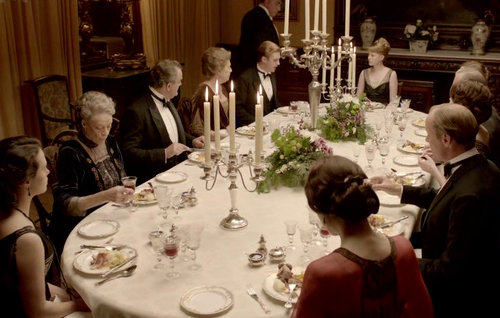
            Although most do not stop to think about why, meals are scarce in literature for the most part. Due to the fact that it is extremely difficult to write about an event so commonplace as sitting down to join in a meal in an interesting way, authors rarely include the gathering unless it is to signify something bigger and more important. As Foster says, eating is usually considered a very intimate occurrence. Thus, eating in literature often signals a turning point in the way one character feels toward another.
            Meals can also point to status. Elaborate foods and serving dishes signify high status and abundant wealth, cluing the reader in to the every day lives of the characters, whereas smaller portions and simpler foods tend to indicate lower status. By using something that everyone takes part in, every reader is able to relate to the characters on some level. In a sense, it brings the reader closer to all of the characters that are eating in addition to uniting the characters taking part in the activity. This is incredibly important in literature because most people hesitate to continue reading if they do not relate to the characters or their experiences in some way or another.
            An advantage of taking the time and energy to write about a meal is that it can convey something much more interesting and complex than simply ingesting sustenance. In Virginia Woolf’s essay “Two Meals,” she is able to describe something as intricate as the differences between how men and women were treated using only the descriptions of the meal she received at two colleges she visited: the men’s college and the women’s college. At the men’s college, she was treated to luxuriant dishes and multiple courses. However, at the women’s college, she was given a very plain and altogether unremarkable meal. With her accounts of the meals, she achieved something much larger than simply recounting and reviewing the meals she received. “Two Meals” is a prime example of how meals are shown in literature. Woolf was able to make a statement about society and the treatment of women with only two paragraphs, which goes to show the impactful way meals can be portrayed in literature.
            As Foster says, meals in literature are not always good omens. Because of the way we treat meals as a sign of friendship and peace, we are all the more upset when one of the people at the meal is revealed to have been plotting against the others. This immediately turns us against the character that had been conspiring against someone who trusted them enough to invite them to a meal together. This nearly instantaneous reaction has been ingrained into our brains from the time we were young children through the importance most of our parents placed on table manners. The fact that manners specifically for the table have been devised makes it all the easier to believe that humans place an inordinate amount of importance on meals.

            The incredible reverence of meals in literature makes it much easier to realize that most mundane events are placed in literature for a reason. It is no longer a simple walk to the store or an outing to the ice cream parlor. It is a means for something much more important to be conveyed to the reader.

Sunday, June 29, 2014

The Never-Ending Dragon Battles


The first chapter of the book presents an interesting concept: that every journey in a story is to be automatically considered a quest. In my experience, this is overwhelmingly true, especially in action and adventure novels. Like the author states, the entire Lord of the Rings series consists of quest upon quest, with the stated purpose being to destroy the ring and the actual purpose being to overcome the temptation the ring holds. Gollum represents an alternate path for Frodo, the one that would come if he chose to keep the ring and attempt to harness its power. In vanquishing Gollum in the fires of Mount Doom, Frodo defeats the other choice and finds self-knowledge.
            However, the author writes that not all journeys in stories automatically mean that a quest is at hand. As he states, some trips must occur in order for the plot to continue, but the mere fact that a trip is occurring does not imply or demand that it is a quest. These types of journeys occur all the time in literature. They are important for the plot to keep rolling forward but not important to the overall quest or purpose of the protagonist. Because they do not directly influence the main “point” of the story, most of these trips fade into obscurity, left out of summaries, altogether insignificant.
            The vast majority of novels fall into the quest type of story due to the fact that nearly everyone can identify with it in some capacity. Children have begun their journeys to self-knowledge however unwittingly, thus, they identify with the actual journey portion of the quest. As new members to the human race, children face their lives stretching out before them in a similar way to that in which questers see their journey before they begin. They have conflicts and troubles to face down the road. The dragons, if you will. Teenagers are caught between the realms of childhood and adulthood, like the quester who has recognized that the stated purpose is not the only thing that matters; that they have another, more self-fulfilling purpose to achieve on the quest. Teenagers have not yet begun the journey to complete the actual purpose, but realize its existence. Adults relate to the quester due in part to the fact that they likely went through a similar journey to self-knowledge in their childhood and adolescence and are remembering each of the stages of their own quest, and in part because they relate to the quester at the end of his or her journey. They can relate to the feeling of achieving the goal, completing the quest, and looking for the next quest, just like the quester could face another quest in sequels to come.

            Although it would be a stretch to say that every novel is a quest type of story, there have been so many of this type due to the incredible way in which people of all ages are intrigued by and relate to the quest story in multiple ways. Besides the age factor, there is a gender factor. The majority of girls wished to be the princess in all the stories at some point in their childhoods. And most boys fantasized about saving a princess in some way, battling the dragon to win her heart. Humans tend to enjoy those things we understand and can make connections with, and the quest storyline is no exception to that.